G.SKILL Trident Z5 DDR5 Review: Hardware Compatibility and Reliability Analysis
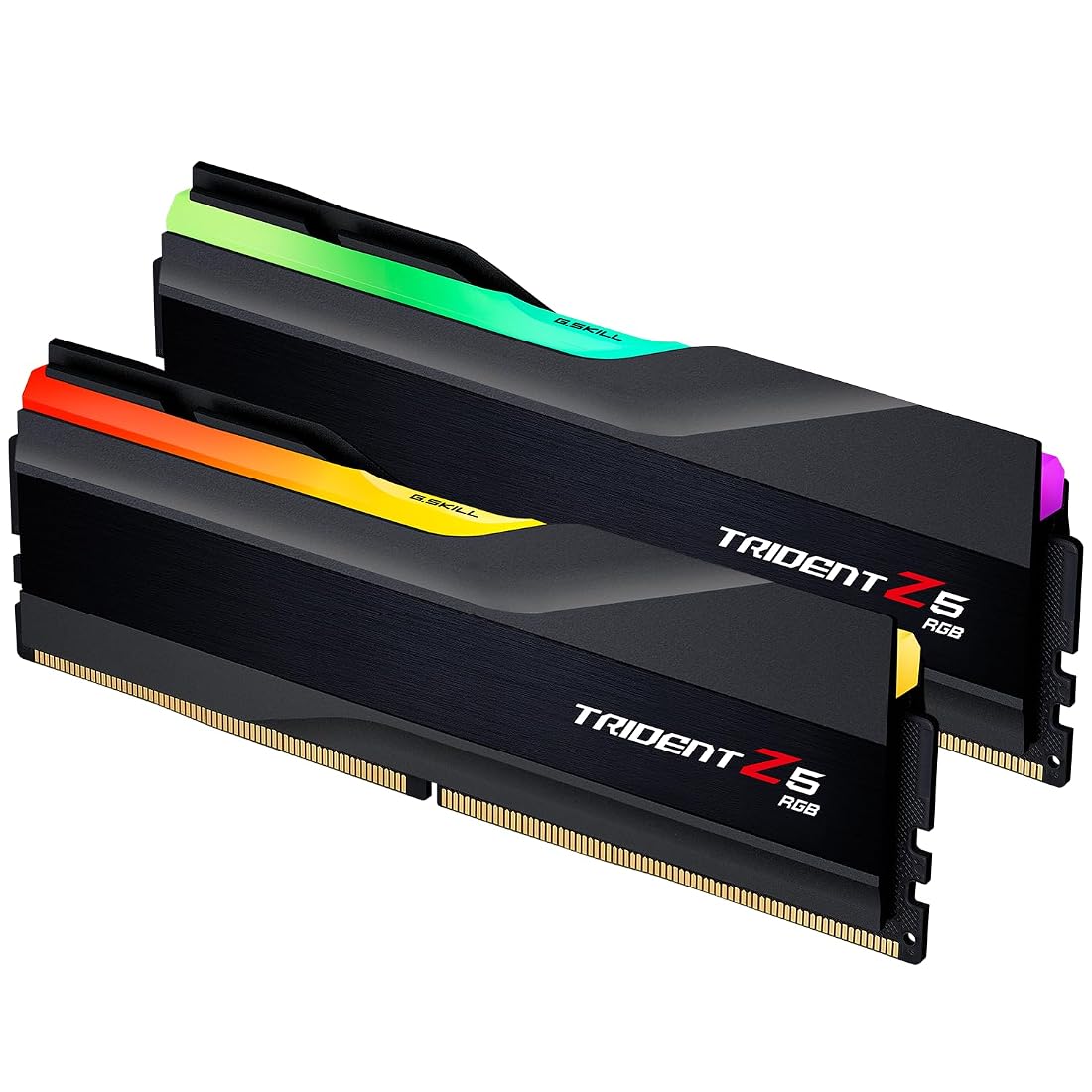
The G.SKILL Trident Z5 DDR5 is a dual-channel 32GB desktop memory kit engineered to deliver transfer rates up to 6000MT/s through pre-configured Intel XMP 3.0 and AMD EXPO overclocking profiles. Rated with primary timings of CL36-36-36-96 at 1.35 volts, this unbuffered 288-pin UDIMM package is designed specifically for modern desktop motherboards and performance builds. However,…
As Amazon Associates, we earn from qualifying purchases. This means we may receive a small commission at no extra cost to you if you click through and make a purchase.
The G.SKILL Trident Z5 DDR5 is a dual-channel 32GB desktop memory kit engineered to deliver transfer rates up to 6000MT/s through pre-configured Intel XMP 3.0 and AMD EXPO overclocking profiles. Rated with primary timings of CL36-36-36-96 at 1.35 volts, this unbuffered 288-pin UDIMM package is designed specifically for modern desktop motherboards and performance builds. However, reaching its advertised transfer speeds requires manual BIOS adjustments and full hardware synergy with validated processor memory controllers rather than pure plug-and-play installation.
This desktop memory kit suits performance-minded PC builders and gamers who are comfortable configuring motherboard firmware and verifying qualified parts lists before purchasing. Enthusiasts who demand native operational stability without touching UEFI settings, as well as builders planning high-density multi-kit configurations, should look elsewhere due to strict hardware boundaries and clear manufacturer restrictions against combining memory packages.
G.SKILL Trident Z5 DDR5 spec sheet
| Model Number | F5-6000J3636F16GA2-TZ5RK |
|---|---|
| Memory Generation and Type | DDR5 Non-ECC UDIMM |
| Pin Count | 288-pin |
| Total Capacity | 32GB (2 x 16GB Matched Kit) |
| Rated Transfer Rate | Up to 6000 MT/s (6000 Mbps) |
| Tested Timings | CL36-36-36-96 |
| Tested Voltage | 1.35V |
| Overclock Profile Support | Dual Profile Support (Intel XMP 3.0 and AMD EXPO) |
| Supported Chipset Platforms | Intel Z890, Z790, Z690, B860, B760, B660 and AMD X870, X670, B850, B840, B650, A620 |
| Item Weight and Finish | 0.17 kg, Matte Black |
Every field from the listing (25)
| 0 | RAM Memory Technology, DDR5 |
|---|---|
| 1 | Memory Speed, 6000 mt_s |
| 2 | Compatible Devices, Desktop |
| 3 | Additional Features, Dual OC Profile Support (Intel XMP 3.0 & AMD EXPO) |
| 4 | Voltage, 1.35 volts |
| 5 | Column Address Strobe Latency, 36 |
| 6 | Form Factor, DIMM |
| 7 | Data Transfer Rate, 6000 megabits_per_second |
| 8 | Number of Pins, 288 |
| 9 | Memory Form Factor, UDIMM |
| 10 | Memory Generation, DDR5 |
| 11 | RAM Size, 32 GB |
| 12 | Brand, G.SKILL |
| 13 | Model Name, Trident Z5 RGB |
| 14 | UPC, 848354041061 |
| 15 | Number of Items, 2 |
| 16 | Manufacturer, G.SKILL |
| 17 | Item Weight, 0.17 kg |
| 18 | Item Type Name, DDR5 SDRAM Intel XMP |
| 19 | Model Number, F5-6000J3636F16GA2-TZ5RK |
| 20 | Mfr Part Number, F5-6000J3636F16GA2-TZ5RK |
| 21 | Warranty Description, Limited Lifetime Manufacturer |
| 22 | Best Sellers Rank, #41 in Computer Memory |
| 23 | ASIN, B09PTGZM6Y |
| 24 | Computer Memory Size, 32 GB |
Quoted from the product listing. We did not measure these figures.
01Motherboard QVL Validation and Platform Compatibility
Hardware compatibility forms the foundation of any high-speed memory deployment, and this memory kit targets an expansive range of platforms across both major processor ecosystems. Supported Intel chipsets include the flagship Z890, Z790, and Z690 tiers alongside mainstream B860, B760, and B660 motherboards. On the AMD side, the memory supports X870, X670, B850, B840, B650, and entry-tier A620 motherboards. However, the presence of a motherboard chipset on a broad marketing list does not guarantee that every specific board will train and run these modules at their full 6000MT/s rating without comprehensive firmware optimization.
Reliable operation depends on consulting the official g skill trident z5 qvl list or utilizing the online G.SKILL RAM Configurator tool before assembling hardware. Qualified Vendor Lists confirm that the exact motherboard model and BIOS revision have undergone factory signal trace validation with this specific module part number. Builders considering competitive alternatives such as the teamgroup t-create 32gb ddr5 6000mhz kit must realize that memory controller quality on lower-end boards, particularly entry-level chipsets like the A620 or B760, can limit signal integrity under sustained workloads.
When installed into a system running default motherboard settings, the modules boot automatically to standard JEDEC SPD default speeds rather than their advertised 6000MT/s overclocked frequency. This built-in failsafe ensures basic display output and UEFI navigation, giving system builders the stable baseline necessary to update firmware before attempting higher clock frequencies. Attempting to bypass QVL verification frequently results in boot failure, aggressive memory retraining loops, or automatic downclocking to base JEDEC parameters.
02Profile Stability and BIOS Overclocking Architecture
Achieving rated speeds on this memory module relies on dual overclocking profile support, integrating both Intel XMP 3.0 and AMD EXPO standards into a single unified kit. This trident z ddr5 expo xmp compatibility simplifies platform migrations, allowing users to swap between modern Intel and AMD motherboards without purchasing platform-specific hardware. Activating these profiles within the BIOS instructs the motherboard to load tested primary timings of CL36-36-36-96 alongside an operating voltage of 1.35V.
Long-term trident z ddr5 stability at 6000MT/s requires sufficient voltage delivery from the motherboard integrated memory controller and stable power management circuitry. The listing explicitly states that maximum speed and performance depend directly on system components, including the motherboard and processor. If a processor integrated memory controller possesses weaker silicon characteristics, running trident z ddr5 6000mhz profiles can cause random application crashes, memory read errors, or sudden operating system restarts under sustained processing tasks.
Overclocking profiles represent pre-validated factory targets rather than guaranteed universal outcomes. Motherboard firmware versions play a massive role in whether secondary and tertiary sub-timings are set correctly. System assemblers must keep motherboard BIOS builds updated to recent releases, as board vendors continuously patch memory training algorithms to handle 1.35V profiles reliably across disparate CPU samples.
03Performance Characteristics and Hardware Demands for Gaming
Modern gaming titles and high-throughput desktop applications demand consistent data flow between the processor and system memory. Reviewing the trident z ddr5 specs highlights a CAS latency of 36 paired with 6000MT/s bandwidth, creating a balanced latency-to-bandwidth ratio that feeds modern multi-core processors effectively. Deploying trident z ddr5 for gaming delivers steady frame generation by minimizing processing pauses during intensive open-world asset streaming and high-framerate rendering passes.
The 32GB total density, supplied as two matched 16GB unbuffered DIMMs, occupies both primary channels of standard consumer desktop motherboards without overloading the bus topology. Prebuilt gaming rigs, such as mainstream machines featuring an rtx 5050 16gb graphics card, often balance system processing bottlenecks against memory responsiveness, making a dual-channel 32GB configuration standard for modern gaming demands. Running two DIMMs rather than four maintains cleaner signal traces, allowing modern memory controllers to achieve stability with less electrical strain.
System builders must also consider thermal overhead within the desktop chassis. While the listing notes an overall item weight of 0.17 kg and a Matte Black finish, maintaining 1.35V during extended gaming sessions requires adequate case airflow. Confined desktop enclosures with restricted ventilation can lead to heat buildup around the UDIMM slots, which degrades stability and increases the likelihood of memory parity anomalies during prolonged gaming marathons.
04Reliability Risks and the Dangers of Mixing Kits
A critical reliability directive from the manufacturer addresses multi-kit configurations: never combine multiple memory kits. G.SKILL explicitly warns that these modules are sold as matched kits designed exclusively to run together as a single set. Combining two separate retail packages—even two kits sharing the exact same F5-6000J3636F16GA2-TZ5RK part number—frequently leads to system instability, boot failures, or complete operational refusal.
Understanding the trident z ddr5 failure rate requires separating manufacturing flaws from user configuration errors. When memory modules fail to POST or exhibit data corruption, the issue is frequently traced back to unvalidated four-DIMM setups or combined kits. Each factory package is binned and matched for electrical characteristics, printed circuit board impedance, and internal component tolerances. Doubling the module count to four sticks places severe capacitive loading on the memory traces, forcing aggressive memory controller degradation or manual frequency reductions.
Furthermore, desktop UDIMMs differ substantially from low-power SODIMM memory architectures found in business notebooks like the t14 gen 4 mobile platform. Desktop kits require specialized platform design, strict attention to motherboard topology, and adherence to rigid operating rules. Deviating from these manufacturer boundaries compromises stability, and users who attempt unapproved combinations risk data loss through silent background file corruption.
05Warranty Terms and Technical Support Limitations
The listing outlines clear boundaries regarding component operation and customer protection policies. G.SKILL explicitly warns that usage in any manner inconsistent with manufacturer specifications, warnings, designs, or recommendations will result in lower speeds, system instability, or permanent damage to the system and its components. Prospective buyers must consult the official G.SKILL warranty policy webpage to understand the specific limitations and claim requirements tied to retail memory packages.
When evaluating trident z ddr5 warranty support, builders must understand how overclocking profiles intersect with manufacturer service terms. Operating the memory at 6000MT/s through XMP 3.0 or AMD EXPO constitutes an overclock beyond standard JEDEC baseline speeds. While the hardware modules feature internal thermal spreaders and are tested to withstand 1.35V, motherboard faults, manual voltage adjustments beyond factory profiles, or physical mishandling during installation can complicate standard Return Merchandise Authorization claims.
Securing reliable support begins with documenting system compatibility upon initial assembly. Technical support teams typically require proof that the motherboard model appears on the qualified list and that the system uses an approved processor before approving replacements for memory-related stability issues. Ensuring compliance with the manufacturer platform guidance eliminates bureaucratic friction if warranty service or technical troubleshooting ever becomes necessary.
The verdict
G.SKILL Trident Z5 DDR5
9.4/10
Our score
Overwhelmingly positive
Scores are out of 10, based on listed specifications and buyer feedback.
Deciding if the trident z ddr5 is worth it comes down to motherboard preparation and an understanding of high-speed desktop memory architecture. As highlighted throughout this g skill trident z5 ddr5 review, the kit combines flexible dual-profile overclocking with reliable 6000MT/s performance when deployed in verified platforms. Its support for both Intel XMP 3.0 and AMD EXPO makes it exceptionally versatile across changing platform generations, provided the host motherboard is equipped to handle 1.35V operation.
However, reliability remains tightly linked to system configuration. Buyers must verify their components against the official Qualified Vendor List, avoid the temptation to mix distinct memory packages, and ensure proper chassis airflow across the unbuffered DIMM slots. When installed into a validated dual-channel setup with an updated BIOS, this memory kit delivers dependable high-speed performance for demanding desktop environments.
Pros
- Dual Intel XMP 3.0 and AMD EXPO profile support
- Tested 6000MT/s transfer rate on validated boards
- Balanced CL36-36-36-96 primary timings at 1.35V
- Broad compatibility across modern Intel and AMD chipsets
- Safe JEDEC baseline profile for out-of-box booting
Cons
- Requires manual BIOS configuration to achieve rated speeds
- Combining multiple separate kits causes severe instability
- Full stability depends on motherboard and processor silicon
Buy it if
- You own an Intel 600/700/800 series or AMD 600/800 series motherboard verified on the G.SKILL QVL.
- You are experienced with enabling Intel XMP 3.0 or AMD EXPO profiles within your motherboard UEFI.
- You need a 32GB dual-channel desktop configuration optimized for gaming and intensive multitasking.
- You want dual-profile memory flexibility to keep your hardware compatible across future Intel or AMD builds.
Skip it if
- You expect rated 6000MT/s transfer rates out of the box without configuring BIOS settings.
- You intend to buy two separate kits to configure a 64GB four-slot memory layout.
- Your system uses an unlisted motherboard model that lacks official factory validation.
See it on AmazonAffiliate link. Price and stock change at Amazon, not here.
Questions buyers ask
Does the G.SKILL Trident Z5 DDR5 boot at 6000MT/s automatically?
No, the memory boots at JEDEC default SPD speeds when installed under factory default BIOS settings. Achieving the advertised 6000MT/s transfer rate requires entering the motherboard UEFI firmware and manually enabling the pre-programmed Intel XMP 3.0 or AMD EXPO overclocking profile.
Can you combine two of these kits to create a 64GB setup?
No, the manufacturer explicitly warns against mixing memory kits. Each 32GB kit is factory-matched to run together as a distinct pair. Combining two separate kits on a single motherboard, even with identical part numbers, leads to signal mismatch, severe stability failures, and boot issues.
How do you verify motherboard compatibility before buying?
Buyers should consult the official G.SKILL memory QVL or use the RAM Configurator tool on the manufacturer website. These tools list specific motherboard models and chipset families, including Intel Z-series and AMD X/B-series boards, that have passed factory validation testing with this memory model.
What is the difference between the Intel XMP and AMD EXPO profiles on this kit?
Intel XMP 3.0 and AMD EXPO are platform-specific overclocking instruction sets stored directly on the memory module. Having dual-profile support allows the same physical memory kit to load pre-tested voltage and timing values seamlessly whether installed on an Intel or AMD desktop motherboard.
What should you do if the system fails to boot after enabling the overclock profile?
If the system fails to boot with XMP or EXPO enabled, update your motherboard BIOS to the latest manufacturer release to improve memory training algorithms. If stability issues persist, verify that your motherboard is on the official QVL and ensure your processor memory controller supports 6000MT/s operation.
How this review was put together
- Specs are quoted from the Amazon listing, not measured in a lab.
- The score is out of 10, based on listed specifications and buyer feedback.
- Prices were read from the listing when this page was last built and move without notice.
607 reviews · 1,445 rated products · 87 brands tracked
We earn a commission when you buy through our Amazon links. That never changes a score.


