Wonderquest Pro Digital Microscope Review: Build Quality & Real Limits
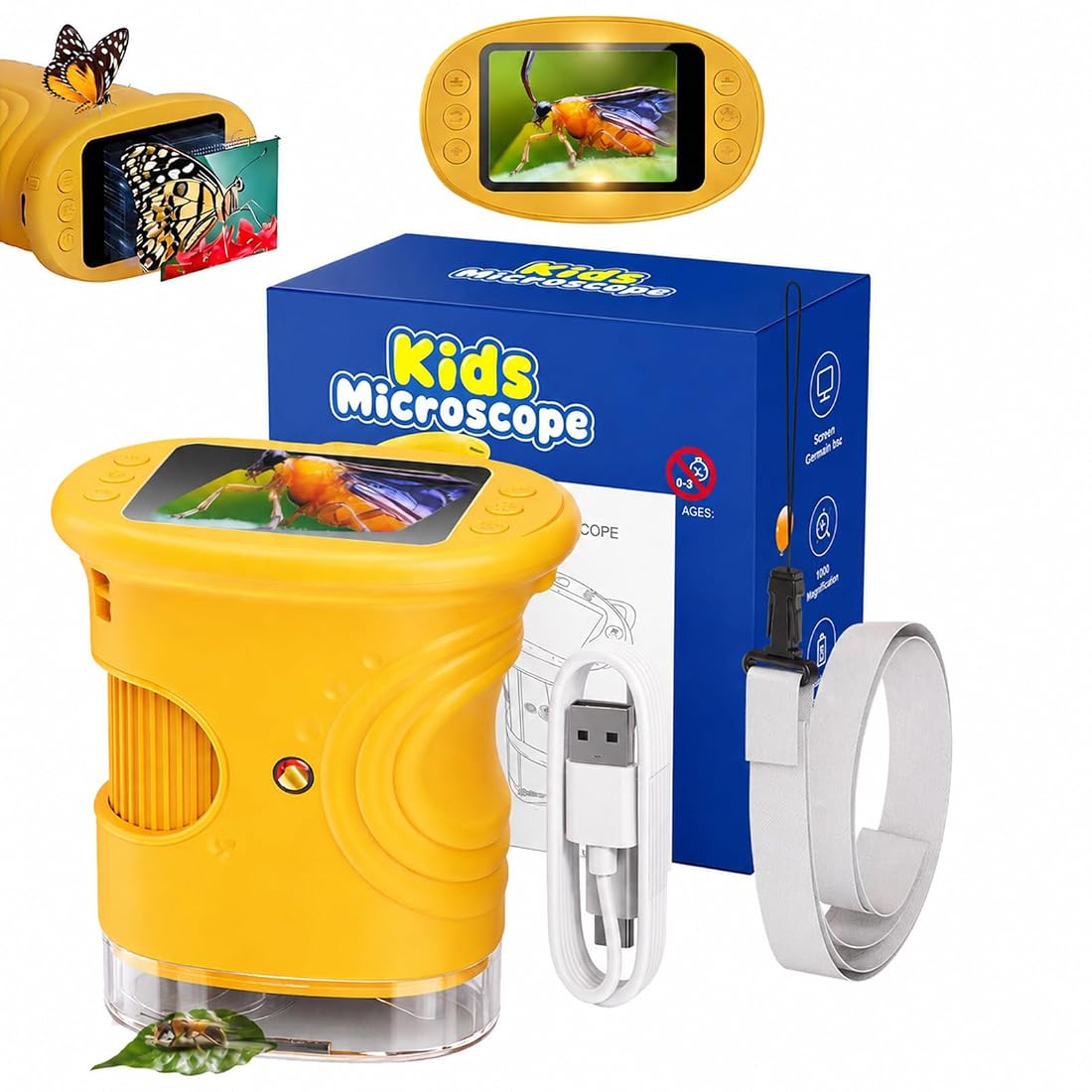
The Wonderquest Pro Digital Microscope enters the portable STEM market as an accessible, handheld observation tool tailored for backyard exploration, introductory science classes, and casual surface examination. Designed around a bright yellow plastic housing with a 2-inch IPS viewing screen, an advertised 1000x magnification ceiling, adjustable LED lighting, and an integrated 4K magnifying camera sensor,…
As Amazon Associates, we earn from qualifying purchases. This means we may receive a small commission at no extra cost to you if you click through and make a purchase.
The Wonderquest Pro Digital Microscope enters the portable STEM market as an accessible, handheld observation tool tailored for backyard exploration, introductory science classes, and casual surface examination. Designed around a bright yellow plastic housing with a 2-inch IPS viewing screen, an advertised 1000x magnification ceiling, adjustable LED lighting, and an integrated 4K magnifying camera sensor, this battery-powered miniscope attempts to merge the convenience of an electronic pocket loupe with digital capture capabilities. For cautious shoppers evaluating hardware claims, our comprehensive analysis indicates that while the device serves as an engaging, lightweight gateway for students to inspect rough textures and insect wings, buyers must maintain realistic expectations regarding digital zoom limitations and consumer-grade plastic construction.
This compact inspection gadget best serves parents, elementary educators, and curious young learners who want an all-in-one handheld viewer that operates without slide preparations or complex optical alignment. Its cordless footprint and simplified controls allow children to examine garden flora, textiles, and everyday household surfaces with minimal supervision. Conversely, home laboratory hobbyists, university students, and precision technicians requiring certified optical resolution, micrometric focus mechanisms, or guaranteed drop resistance should look past this unit, as the manufacturer listing does not specify laboratory-grade optical tolerances or ruggedized exterior armoring.
Wonderquest Pro Digital Microscope spec sheet
| Brand | Wonderquest |
|---|---|
| Manufacturer | Wonderquest |
| Manufacturer Part Number | 1 |
| Form Factor | Handheld portable USB digital miniscope |
| Magnification Maximum | 1000x (adjustable focus controls) |
| Display Panel | 2-inch IPS screen |
| Imaging Sensor | Advertised 4K photo and video capture |
| Light Source | Adjustable integrated LED lighting |
| Power Configuration | Battery powered (batteries not included) |
| Chassis Color | Yellow |
Every field from the listing (11)
| 0 | Brand, Wonderquest |
|---|---|
| 1 | Unit Count, 1 Count |
| 2 | Number of Items, 1 |
| 3 | Number of Packs, 1 |
| 4 | Manufacturer, Wonderquest |
| 5 | Manufacturer Part Number, 1 |
| 6 | Best Sellers Rank, #241 in Camera & Photo Products (See Top 100 in Camera & Photo Products) #36 in Lab Handheld Digital Microscopes |
| 7 | ASIN, B0GC427W2L |
| 8 | Light Source Type, LED |
| 9 | Magnification Maximum, 1000 x |
| 10 | Color, Yellow |
Quoted from the product listing. We did not measure these figures.
01Optical Capabilities and Magnification Realities
Evaluating the optical claims of consumer microscopes requires separating true optical enlargement from electronic sensor cropping. The manufacturer promotes a 1000x magnification capability, positioning the device for examining intricate subjects such as insect wings, plant cells, and woven fabric textures. In miniature handheld digital microscopes, true optical magnification is governed by the tiny focal length of the objective lens element, which typically provides modest baseline optical enlargement. The remainder of the claimed 1000x ceiling is achieved via digital interpolation, where the onboard image processor crops and stretches the central pixel grid across the integrated 2-inch IPS display.
When buyers consider conducting a practical wonderquest 1000x magnification test, they should understand the physical laws of microscopy. Resolving genuine intracellular anatomy, such as individual plant cell nuclei or bacterial cultures, requires numerical apertures and glass immersion systems that compact pocket units simply cannot house. When reviewing similar field magnifiers such as the miniscope pro little marvin, we see a consistent design pattern: these handheld loupes excel at revealing macroscopic surface topographies, such as stomata on broad leaves, butterfly scale groupings, stamp paper fibers, and skin ridges, rather than sub-micron cellular biology.
The integrated imaging system is labeled as a 4K magnifying camera capable of capturing still images and video footage independently. While the presence of a digital camera sensor allows students to record visual evidence for science fair projects, the listing does not specify the native pixel count of the underlying CMOS sensor versus digitally upscaled output. For field documentation, the adjustable manual focus dial provides the primary means of sharpening the image on screen. Users must hold their hand remarkably steady at high digital zoom ratios, as minor hand tremors will cause noticeable image blur on the small display panel.
02Chassis Construction and Field Durability
A central concern for parents and school procurement coordinators is overall wonderquest pro digital microscope durability. The unit features a distinctive yellow casing shaped with an ergonomic grip intended for comfortable single-handed operation by children and adults alike. Constructed from molded plastics, the entire assembly remains exceptionally lightweight and cordless, facilitating uninhibited movement through gardens, parks, and school science laboratories without dragging tethered cables through soil or workspace clutter.
Despite its kid-friendly form factor, careful buyers should examine how the plastic shell handles regular classroom abuse. The listing does not specify any rubberized corner bumpers, reinforced drop cushions, or an official ingress protection rating against moisture and fine dust. The lens opening rests close to the working surface, meaning loose garden dirt or abrasive sand could contact the optical bezel if the tool is placed directly into muddy terrain. Handling requires reasonable mindfulness; while the lightweight plastic body avoids the fragile bulk of heavy cast-iron laboratory frames, an accidental fall from a desk onto a tiled floor could stress the plastic lens retainers or crack the display cover.
From an ergonomic perspective, the simplified single-hand button layout is well-positioned for thumb or index-finger access during field exploration. Designing pocket electronics with targeted balance points is critical for stable handling, a dynamic frequently observed in specialized input hardware like the meta quest pro controller, where intentional grip geometry reduces hand fatigue during continuous interaction. On the Wonderquest Pro, the lightweight body prevents wrist fatigue during lengthy nature walks, though very young users may still benefit from resting the barrel on a flat surface or small book to eliminate jitter when attempting to capture clean photos.
03Display Clarity and Single-Hand Interface
The built-in screen serves as the primary observation portal for this digital miniscope. The unit incorporates a 2-inch IPS screen, which represents a notable technical advantage over older, basic twisted-nematic (TN) panels. The primary benefit of an IPS panel is wider viewing angles and superior color consistency. When a child holds the microscope at an angle to inspect tree bark or a sibling peers over their shoulder to see the specimen, the wonderquest discovery microscope screen quality maintains legible color and contrast rather than inverting colors or washing out when viewed off-axis.
Nevertheless, a 2-inch viewing diagonal imposes obvious visual constraints. Identifying fine focal boundaries on a display that measures only two inches across requires sharp vision and steady ambient conditions. While the compact display makes the entire unit pocket-friendly and easy to pack into a backpack, it is not optimized for group presentations. In classroom settings, students must crowd closely around the operator to view the live feed, making it more of an individual exploration tool than a communal laboratory workstation.
The operational interface relies on simplified button controls arranged for friendly single-hand operation. Users can toggle modes and trigger independent image or video capture without releasing their grip on the specimen or adjusting secondary dials. The unit also features a USB digital miniscope interface, allowing users to offload captured media files to an external computer for closer inspection. Offloading captured files to a dedicated school workstation or mini desktop like the asus nuc 14 provides students with a larger monitor to study the recorded textures, write lab reports, and analyze specimen details that are difficult to evaluate on the small 2-inch onboard screen.
04Illumination Control and Power Delivery
Adequate illumination is the single most critical factor in reflected-light microscopy. Because handheld digital microscopes are placed directly against or within millimeters of the target object, the body of the tool inevitably blocks incoming ambient sunlight or room lighting. To counter this, the Wonderquest Pro integrates an adjustable LED light source surrounding the objective area. The listing highlights that users can customize the LED brightness level, ensuring an optimal view whether inspecting transparent biological samples, semi-translucent insect wings, or highly reflective, dark metallic surfaces.
The ability to tune the lighting output directly addresses common lighting pitfalls in hobbyist optics. Solid, dark materials require maximum illumination to reflect sufficient photons back into the sensor, whereas pale, translucent plant slices wash out into pure white glare if flooded with unmanaged light. The adjustable control lets users dial down intensity to preserve specimen contrast. However, the listing does not specify whether the LED array includes diffusion baffling, so users inspecting polished coins, glossy rocks, or slick plastics may encounter localized specular highlights or hotspot reflections in their captured images.
Power management is an essential operational detail that cautious shoppers must plan for ahead of purchase. The listing specifies a cordless construction that requires batteries, but explicitly notes that batteries are not included in the package. Crucially, the product listing does not specify the exact battery chemistry, cell format (such as AAA or AA alkaline cells), or whether internal rechargeable support is present. Because the power circuit must simultaneously drive an active 2-inch IPS color display, an integrated digital image sensor, and multiple continuous LED bulbs, wonderquest pro handheld microscope battery life will depend heavily on the quality of cells inserted by the user. Preparing an inventory of reliable rechargeable or high-capacity alkaline cells is essential for uninterrupted field sessions.
05Educational Utility and Classroom Integration
Assessing the wonderquest pro digital microscope specs in the context of educational curricula demonstrates where this device delivers practical value. The listing emphasizes broad learning compatibility, framing the unit for classroom or home educational projects centered on nature documentation and microscopic discovery. Rather than keeping science confined to rigid benchtop stations, the portable nature of this miniscope encourages tactile, inquiry-based learning directly in the field.
Students can apply the device across a diverse spectrum of introductory science modules. In botany lessons, children can inspect the protective hair layers on leaves, stamen structures in blossoms, and fungal spores on rotting timber. In geology units, the adjustable illumination helps differentiate coarse crystalline structures in granite from smooth river silt. In home economics or materials science activities, students can explore the varying thread weaves between synthetic polyester and natural wool fibers. Because the tool operates independently without requiring an active computer connection during observation, field trips remain unencumbered by peripheral hardware.
At the same time, teachers should structure activities around the physical realities of the hardware. Because the unit lacks a mechanical stage, slide clips, or fine vernier micrometers, it cannot replace standard biological compound microscopes required for high school cell staining, blood cell counting, or histology slides. It functions best as an exploratory electronic loupe that bridges the tactile gap between a standard 10x magnifying glass and stationary laboratory hardware.
The verdict
Wonderquest Pro Digital Microscope
9.2/10
Our score
Very positive
Scores are out of 10, based on listed specifications and buyer feedback.
Determining whether the Wonderquest Pro Digital Microscope is worth it comes down to matching buyer expectations with the operational realities of entry-level digital optics. The device succeeds in delivering an approachable, self-contained, and cord-free exploration platform that sparks scientific curiosity in young learners. Its lightweight yellow chassis, ergonomic contouring, and responsive single-hand button interface make inspecting garden foliage, insect wings, and household fabrics intuitive and fun. Furthermore, incorporating an IPS panel ensures that viewing angles and colors remain legible during outdoor family nature walks.
However, cautious buyers must recognize the explicit boundaries of this hardware class. The advertised 1000x magnification relies significantly on digital enlargement rather than complex multi-element optical glass, meaning high-magnification captures will exhibit softness and motion blur if not held perfectly motionless. With batteries omitted from the box and no published drop or water-resistance ratings, the unit requires supplementary battery purchases and careful handling in outdoor environments. For families and primary school classrooms seeking an engaging, screen-equipped electronic magnifying loupe, it offers solid functional utility as long as users do not expect professional laboratory performance.
Pros
- Lightweight handheld body with ergonomic grip
- Integrated 2-inch IPS color display
- Adjustable LED brightness for diverse specimens
- Single-hand button interface for photos and videos
- Cordless design for outdoor nature exploration
Cons
- Batteries are not included in the package
- Listing does not specify battery type or runtime
- Small 2-inch display restricts group classroom viewing
- Lacks rubberized shock protection against drops
Buy it if
- You need a lightweight, all-in-one portable magnifier for elementary-aged children to explore outdoor nature specimens independently.
- You want an integrated IPS color screen that eliminates the need to squint through a narrow optical ocular lens.
- You value single-handed image and video capture capabilities for documenting basic science fair observations and nature walks.
- You require adjustable built-in LED lighting to examine diverse materials ranging from dark stones to semi-transparent foliage.
Skip it if
- You expect certified laboratory-grade optical resolution capable of resolving bacteria, blood cells, or microscopic internal cell structures.
- You need an out-of-the-box functioning tool that includes factory-supplied batteries or an integrated rechargeable battery pack.
- You require a ruggedized, drop-tested body with rubber armoring and guaranteed environmental weatherproofing for harsh field conditions.
See it on AmazonAffiliate link. Price and stock change at Amazon, not here.
Questions buyers ask
Does the Wonderquest Pro Digital Microscope come with batteries included?
No, the product listing explicitly confirms that while the device features a cordless design requiring batteries for operation, the batteries are not included in the package. Buyers will need to procure compatible cells separately before using the device.
Can the Wonderquest Pro achieve genuine 1000x optical magnification?
The listing claims a 1000x magnification maximum, but in compact handheld digital units of this size, that figure reflects a combination of basic optical lens magnification paired with digital image sensor interpolation. It cannot reproduce the physical resolving power of heavy benchtop compound microscopes used in professional laboratories.
What kinds of specimens are best viewed with the Wonderquest Discovery Microscope?
The device is optimized for surface-level examination of everyday objects, including insect wings, plant leaves, tree bark, fabric textures, printed paper fibers, coins, and coarse minerals. Its adjustable LED lighting helps illuminate both dark opaque surfaces and semi-transparent specimens.
Can you save and transfer images from the Wonderquest Pro to a computer?
Yes, the microscope features a single-hand interface designed to capture photos and videos independently during science activities, along with a USB interface that allows connection to a computer for media file offloading and viewing.
Is the Wonderquest Pro Digital Microscope suitable for young children?
The tool is designed with a lightweight body, an ergonomic grip, and a simple button layout specifically intended for young users engaged in indoor and outdoor learning projects. However, because the housing is made of molded plastic without rubberized shock bumpers, adult supervision is recommended to prevent drops on hard surfaces.
How this review was put together
- Specs are quoted from the Amazon listing, not measured in a lab.
- The score is out of 10, based on listed specifications and buyer feedback.
- Prices were read from the listing when this page was last built and move without notice.
2,605 reviews · 1,445 rated products · 87 brands tracked
We earn a commission when you buy through our Amazon links. That never changes a score.