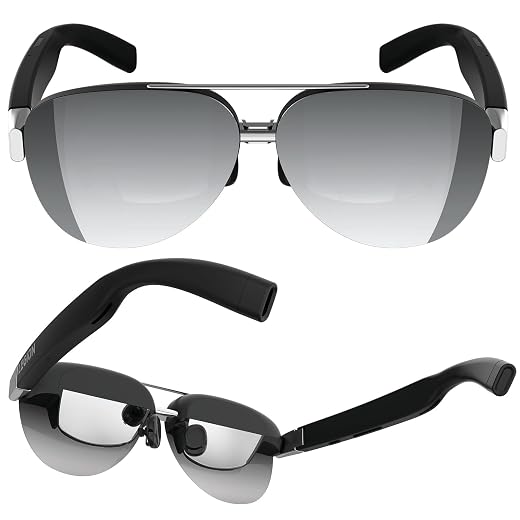
XREAL One Pro Review: Build Quality, Failure Points, and Longevity
The XREAL One Pro enters the augmented reality space with serious display enhancements, integrating custom silicon and an optical redesign aimed at power users and mobile professionals. While its hardware configuration delivers sharp Micro-OLED visuals and responsive tracking, real-world longevity depends heavily on how well its tethered interface, electrochromic layers, and lightweight frame endure daily…

As Amazon Associates, we earn from qualifying purchases. This means we may receive a small commission at no extra cost to you if you click through and make a purchase.
The XREAL One Pro enters the augmented reality space with serious display enhancements, integrating custom silicon and an optical redesign aimed at power users and mobile professionals. While its hardware configuration delivers sharp Micro-OLED visuals and responsive tracking, real-world longevity depends heavily on how well its tethered interface, electrochromic layers, and lightweight frame endure daily mechanical stress. For shoppers analyzing the xreal 1 pro as a long-term display alternative, the device represents an ambitious blend of wearable miniaturization and external display utility, backed by high-end spatial computing specs.
This headset is engineered primarily for travelers, productivity enthusiasts, and portable console gamers who want a massive monitor in their pocket without the bulk of a standalone VR helmet. However, buyers expecting a rugged outdoor wearable or an all-in-one wireless headset with comprehensive water protection will need to look elsewhere, as its tethered architecture and open-frame design demand careful handling and deliberate maintenance.
XREAL One Pro spec sheet
| Display Panel | Sony 0.55-inch Micro-OLED (FHD Resolution, 120Hz) |
|---|---|
| Apparent Screen Size | 171-inch virtual display |
| Field of View | 57 degrees (Optic Engine 4.0 X-Prism Optics) |
| Peak Brightness | Up to 700 nits |
| Spatial Processing | X1 Spatial Computing Chip (Native 3DoF, 3ms M2P latency) |
| Dimming Technology | Advanced electrochromic dimming |
| Audio Architecture | Custom sound chamber tuned by Bose engineers |
| Fit and Ergonomics | Dual IPD sizing (M: 57–66mm, L: 66–75mm) with spring hinges |
| Device Weight | 87 grams |
| Ingress Protection | Not water resistant |
Quoted from the product listing. We did not measure these figures.
01Optical Engine Longevity and Display Quality
At the core of the visual experience is Optic Engine 4.0, which pairs proprietary X-Prism optics with Sony 0.55-inch Micro-OLED panels running at a fluid 120Hz refresh rate. Evaluating the xreal one pro display quality reveals an impressive jump in perceived clarity, producing a 171-inch virtual screen with an expanded 57-degree field of view. By leveraging micro-displays packed into an ultra-slim projection prism, the system preserves high pixel density across the center of your vision. However, optical alignment in prism-based AR glasses is notoriously delicate; physical drops, frame torsion, or rapid temperature fluctuations can compromise optical convergence, resulting in subtle double-vision or edge softness that software cannot recalibrate.
Outdoor visibility relies on up to 700 nits of peak output coupled with electronic light control. The integrated xreal one pro electrochromic dimming layer replaces bulky snap-on shades with electronically tinted glass, allowing users to shift lens transparency at the press of a physical button. While this electrochromic substrate provides seamless transitions between see-through AR and darkened theater viewing, solid-state electrochromic films carry finite operational lifecycles. Frequent state cycling and prolonged exposure to high ambient heat or direct solar radiation can lead to uneven tinting or degraded tint response over years of ownership.
For stationary entertainment, the high refresh rate and contrast of Micro-OLED panels offer a visual profile reminiscent of premium gaming monitors like the asus rog xg27aqdmgr, but miniaturized directly before your eyes. In addition to standard 2D projection, the hardware includes a dedicated switch for REAL 3D mode, converting standard media into stereoscopic formats. Buyers should recognize that pushing maximum brightness alongside 120Hz refresh modes creates noticeable thermal buildup along the upper frame brow, making passive thermal dissipation a defining factor in how comfortably the display operates over extended viewing blocks.
02Physical Architecture and Structural Wear Points
Maintaining an overall weight of just 87 grams required precise material choices, utilizing silicone, rubber contact points, and lightweight temple pieces. When examining the xreal 1 pro durability, the mechanical focal point rests on the spring-loaded hinges and three-stage adjustable arms. The arms flex outward each time you put on or remove the glasses, placing repeated mechanical load on the internal wiring harnesses routed through the hinge pivot points. If these internal flex cables experience metal fatigue from repetitive bending, users risk intermittent video feed dropouts or loss of side-mounted Bose audio channels.
Ergonomics are handled through a dual IPD chassis structure, splitting production into Medium (57–66mm) and Large (66–75mm) frame sizes to accommodate over 95 percent of interpupillary distances. Paired with zero-pressure nose pads available in three distinct sizes, this mechanical adjustability ensures the focal sweet spot aligns with the user’s pupils. Nevertheless, mechanical adjustments introduce points of gradual wear. Silicone nose assemblies and arm angle ratchets can loosen through routine daily use, requiring careful handling to prevent structural play from destabilizing the optical line of sight.
Environmental exposure represents an undeniable vulnerability for this device. The manufacturer listing explicitly states that the hardware is not water resistant. AR glasses lack the sealed gaskets found on sports eyewear, meaning sweat ingress along the temple brow during warm commutes or unexpected rainfall can seep directly into the micro-OLED housing, control switches, or optical cavities. Users tracking long-term reliability must treat the frame as delicate electronic equipment rather than ruggedized eyewear, storing it securely whenever conditions turn damp.
03Spatial Tracking Stability and Processing Architecture
Onboard spatial processing is driven by XREAL’s custom X1 spatial computing chip, which provides native xreal 1 pro 3dof tracking without relying entirely on host device CPU cycles. This custom silicon achieves an ultra-low motion-to-photon latency of 3 milliseconds, stabilizing the virtual screen in place when the user rotates, tilts, or nods their head. Because 3DoF tracking relies primarily on onboard inertial measurement units, gradual sensor drift can occur during extended sessions, requiring occasional visual recentering via the onboard tactile buttons.
The system is also designed to expand its tracking degrees of freedom through external modularity. When paired with the optional XREAL Eye accessory, the setup converts native rotational tracking into full 6DoF spatial anchoring. This allows users to physically walk around or lean toward a floating workspace anchored to a fixed coordinate in a room. The listing notes that without this optional add-on, the glasses remain fixed in 3DoF behavior, keeping screen depth relative to head position rather than your physical room geometry.
Processing spatial computations directly on the frame introduces thermal implications. The X1 chip draws power continuously to maintain tracking stability and manage the rapid 120Hz signal throughput. While offloading tracking computation keeps latency low, users will feel mild warmth radiating along the right temple arm where the primary processing hardware sits. Maintaining frame airflow and keeping the temple vents free from lint or skin oils is essential to prevent thermal throttling during demanding computing or gaming sessions.
04Device Connectivity, Cable Strain, and Gaming Performance
Tethered functionality is central to the design, utilizing a direct USB-C connection to draw power and video signals via DisplayPort Alternate Mode. The hardware supports a broad device ecosystem, including the iPhone 15 and 16 series, video-capable Android smartphones, Windows PCs, MacBooks, and handheld gaming consoles like the Steam Deck and ROG Ally. For mobile gamers, using the xreal 1 pro for gaming unlocks an expansive 120Hz portable canvas, drastically reducing neck strain compared to looking down at a built-in handheld console screen.
Despite broad compatibility, buyers must navigate potential xreal 1 pro compatibility issues stemming from host hardware limitations. Devices without native DisplayPort output over USB-C cannot transmit video without specialized adapters, and certain mobile phones lack the power budget to drive 700 nits of Micro-OLED brightness alongside high-draw audio processing. Handheld gaming consoles also see accelerated battery drain when simultaneously powering the glasses’ X1 processor and optical displays, making multi-port charge-and-play splitters an essential operational accessory for extended gaming sessions.
The constant physical presence of the tethered USB cable introduces a significant wear vector. Because the cord routes from the back of the temple down to a phone, console, or laptop, accidental arm snags apply direct leverage against the glasses’ connector housing. Protecting host devices with rugged accessories like a phone 18 pro max case helps prevent port damage on the smartphone end, but repeated yank force on the eyewear side can loosen internal solder pads. Incorporating strain relief and using flexible, high-spec display cables prevents signal drops and extends the operational lifespan of the connection interface.
05Firmware Lifecycle and Manufacturer Support
Hardware longevity in the AR space is inseparable from companion software maintenance and manufacturer reliability. The XREAL One Pro operates on a proprietary operating system that interfaces with both Android and iOS environments, managing integrated applications for music playback, phone handling, video recording, and camera control when paired with accessory modules. Tracking updates, color calibration profiles, and host compatibility patches arrive via firmware, meaning the long-term utility of the glasses depends on consistent software deployment from the manufacturer.
Evaluating overall xreal one pro reliability requires looking closely at xreal one pro warranty support and post-purchase service structures. While standard consumer protection warranties cover out-of-the-box component failures and internal assembly defects, accidental damage from drops, cable shearing, or liquid exposure is routinely excluded. Sourcing replacement sub-components, such as specialized nose bridge pads or proprietary display tether cables, typically requires interacting directly with brand support channels.
For digital nomads and mobile power users who store extensive workspaces on external drives like the crucial x10 pro, wearable monitors offer unmatched desk-free productivity. However, reliance on proprietary firmware means third-party operating system updates on host devices (such as major iOS or Windows rollouts) can occasionally disrupt display handshakes until manufacturer patches are pushed. Prospective buyers should anticipate occasional setup troubleshooting and maintain realistic expectations regarding ongoing software maintenance timelines.
The verdict
XREAL One Pro
8.8/10
Buyer score
Very positive
Average star rating left by Amazon buyers, doubled to a 10-point scale. It is not a score we gave the product.
When assessing whether the xreal 1 pro is worth it, the decision hinges on how much you value optical performance over physical ruggedness. By integrating the dedicated X1 spatial computing chip, Sony’s 0.55-inch Micro-OLEDs, and high-transmission X-Prism optics, the glasses achieve a level of visual density and low-latency tracking that easily outclasses standard video-mirroring eyewear. The inclusion of electronically variable dimming and sound engineering tuned by Bose creates a genuinely immersive theater experience inside an 87-gram footprint, establishing competitive xreal 1 pro specs that push wearable computing forward.
However, long-term xreal one pro reliability requires an owner who respects its mechanical limits. With zero ingress protection against moisture, delicate spring hinges that channel internal wiring harnesses, and continuous strain on the tethered USB connection, this is a precision instrument rather than durable casual apparel. If you treat the hardware with the care demanded by sensitive optical electronics and pair it with fully compatible host hardware, the XREAL One Pro stands as one of the most capable, visually refined portable monitors currently available.
Pros
- Vibrant 120Hz Sony Micro-OLED display
- Hardware-level 3DoF via X1 chip
- Integrated electrochromic lens dimming
- Acoustic chamber tuned by Bose
- Dual IPD sizing fits wide user range
- Lightweight 87g frame architecture
Cons
- Completely lacks water resistance
- Requires optional accessory for 6DoF tracking
- USB-C tether creates long-term cable strain
Buy it if
- You want a lightweight 87g personal cinema or gaming display featuring vibrant 120Hz Sony Micro-OLED panels and built-in Bose audio.
- You prioritize rapid 3DoF tracking with ultra-low latency powered directly by internal silicon rather than host CPU overhead.
- You travel frequently and value integrated electrochromic dimming to adjust light levels without carrying separate clip-on lenses.
- You own compatible DP Alt Mode devices such as modern iPhones, MacBooks, Windows laptops, or Steam Deck consoles.
Skip it if
- You plan to use the headset in outdoor, rainy, or high-sweat fitness environments where lack of water resistance creates an immediate failure hazard.
- You require standalone, untethered operation without managing an external USB-C cord connected to a host device.
- You want native, out-of-the-box 6DoF spatial tracking without needing to purchase and attach the optional XREAL Eye module.
See it on AmazonAffiliate link. Price and stock change at Amazon, not here.
Questions buyers ask
Does the XREAL One Pro have any water or sweat resistance?
No, the product listing explicitly confirms the glasses are not water resistant. Because the housing features open vents for acoustic chambers, passive thermal heat dissipation, and physical adjustment buttons, moisture from rain or heavy perspiration can enter the frame and permanently damage the internal micro-OLED panels or logic boards.
How does the electrochromic dimming feature function?
The glasses utilize an advanced electrochromic lens substrate that darkens or clears electronically at the touch of a button. This allows users to tint the outer lenses to block out distracting ambient daylight indoors or outdoors, increasing the perceived contrast and vibrancy of the 700-nit virtual display without requiring manual clip-on sunglass shades.
Can the glasses provide 6DoF spatial tracking out of the box?
The glasses provide native 3DoF (degrees of freedom) tracking out of the box via the built-in X1 chip, handling head rotation, pitch, and yaw. Full 6DoF tracking, which allows you to physically walk through or lean closer to anchored virtual screens, requires pairing the glasses with the optional XREAL Eye accessory module.
What devices can connect to the XREAL One Pro?
The glasses connect via USB-C to devices that support DisplayPort Alternate Mode video output. Confirmed compatible hardware includes the iPhone 15 and 16 series, video-capable Android phones, the Steam Deck, ASUS ROG Ally, Apple MacBooks, and compatible Windows PCs. Devices lacking DP Alt Mode functionality cannot output video directly to the display.
How do the dual IPD sizing options work?
Rather than relying on a single compromise frame width, the glasses come in two dedicated hardware frame sizes: Medium (accommodating interpupillary distances from 57mm to 66mm) and Large (covering 66mm to 75mm). Selecting the correct size ensures your eyes sit directly in line with the optical prism sweet spot for maximum edge-to-edge sharpness.
How this review was put together
- Specs are quoted from the Amazon listing, not measured in a lab.
- The score is the average star rating left by Amazon buyers, doubled to a 10-point scale.
- Prices were read from the listing when this page was last built and move without notice.
- Buyer quotes are reproduced word for word, with the name and date shown.
199 reviews · 1,445 rated products · 87 brands tracked
We earn a commission when you buy through our Amazon links. That never changes a score, because we do not set the scores.